- calendar_today August 7, 2025
.
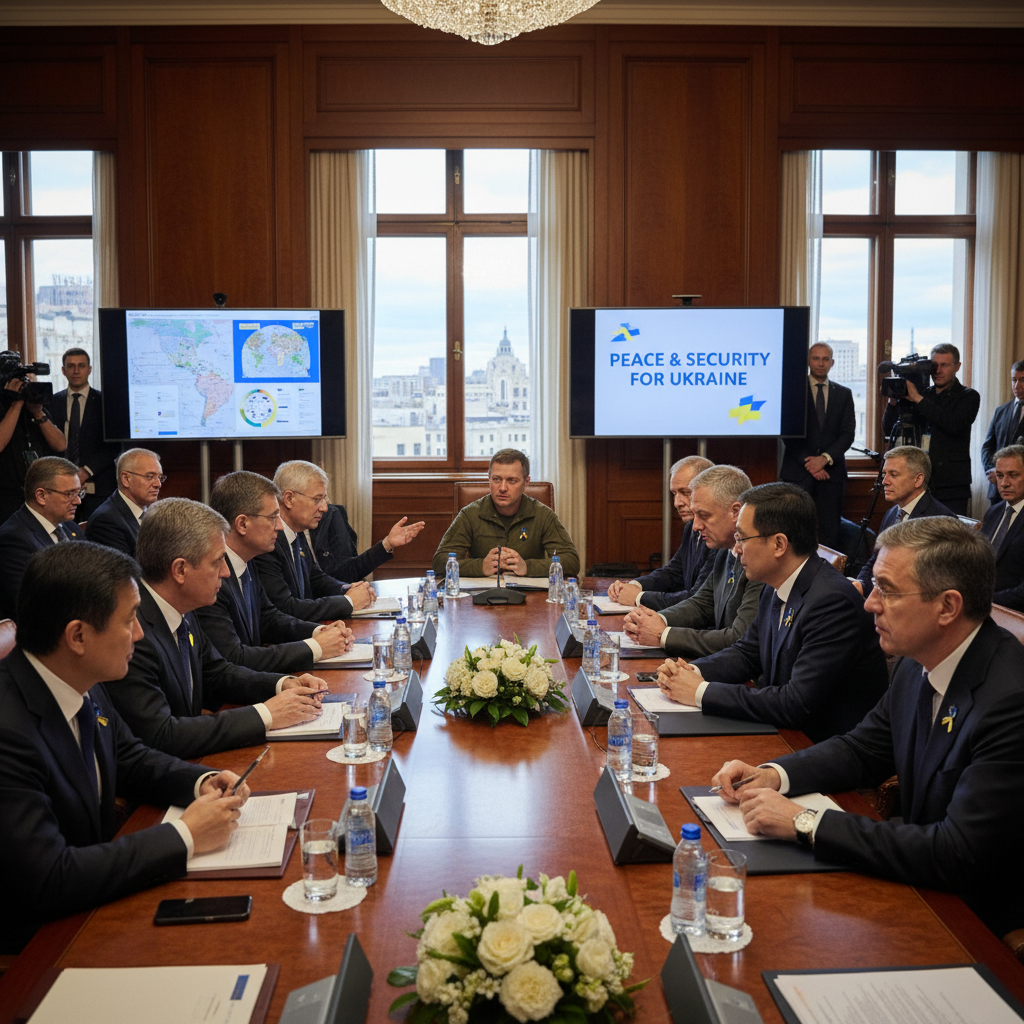
Ukrainian President Volodymyr Zelenskyy said on Monday that he and U.S. President Donald Trump had a “good” talk on the issue of security guarantees for Ukraine, as the country’s war with Russia nears its fourth year.
Speaking at the White House alongside Trump and European leaders, Zelenskyy said security guarantees remain at the heart of Ukraine’s survival and future independence. “The first one is security guarantees. And we are very happy with President [Trump], that all the leaders are here, and security in Ukraine depends on the United States and European countries,” Zelenskyy said. He added that it was “very important” for Washington to signal its readiness to provide strong support, but did not detail what form the guarantees could take.
Trump, too, stressed the issue of security but pivoted to the question of European responsibility, echoing his pre-election rhetoric on the need for European nations to shoulder most of the burden for the war. He also said that the conflict could not be ended without painful discussions over territory. “We’re going to help them, and we’re going to make it very secure,” Trump said. “We also need to discuss the possible exchanges of territory, taking into consideration the current line of contact. That means the war zone, the war line center.”
The West Is Divided over Peace for Ukraine
The White House meeting highlighted the deep divisions that exist among Western leaders over how to balance calls for a negotiated peace and a willingness to provide long-term support for Ukraine. Trump’s apparent willingness to accept territorial concessions directly contradicts Zelenskyy’s repeated statements that Ukraine’s sovereignty and international borders must be upheld.
Negotiations: Sanctions, Ceasefire, and the NATO Question
While White House leaders talked about security guarantees, U.S. lawmakers in Washington were sharpening their rhetoric on the need for tougher sanctions against Russia and its trading partners. In an interview on Sunday, Senator Lindsey Graham, R-S.C., said the Trump administration should go further than current efforts and move to target Moscow’s financial reserves by penalizing countries still buying Russian oil. Graham is co-sponsoring legislation that would empower Trump to levy tariffs of up to 500 percent on states that continue to conduct business with Russia.
“My advice to President Trump and [Secretary of State Marco Rubio] is, you’ve got to convince Putin that if this war doesn’t end justly and honorably with Ukraine making concessions also, we’re going to destroy the Russian economy,” Graham said on Fox News. He added that Trump and Rubio should focus on China in particular to apply maximum pressure. “The second most important person on the planet to end this war is President Xi in China,” Graham said. The U.S. needs to apply pressure in Beijing, Graham added, to make clear to Xi that the war is going nowhere.
Trump has already shown a willingness to use tariffs as leverage, imposing in August a 50 percent tariff on India, at least in part due to New Delhi’s purchases of Russian oil. Graham said he believes that a similar threat against China could change the dynamics on the battlefield almost overnight.
In the European Union, the bloc’s executive arm is working on what will be the 19th round of sanctions against Russia. The new measures, to be published later this month, are expected to further constrict Moscow’s energy revenues, banking access, and military-industrial capacity while plugging loopholes that have opened up for sanctioned parties to do business with Moscow. After more than three years of coordinated Western action, Russia has become the most sanctioned country in modern history, more isolated than Iran, North Korea, or Venezuela.
Sanctions, however, are not the only area of disagreement. European leaders at the White House also pressed Trump on the need for a ceasefire before more serious negotiations could begin. German Chancellor Friedrich Merz argued for a temporary halt in the fighting to allow peace talks to have any credibility. “I can’t imagine that the next meeting would take place without a ceasefire,” Merz said. Trump said he did not see the need for such a measure, pointing to six recent peace agreements that were reached without a truce. “You have a ceasefire, and they rebuild and rebuild and rebuild,” Trump said, though he conceded that the main benefit of a ceasefire would be an immediate halt to civilian deaths.
Also taking part in the White House talks was Finnish President Alexander Stubb, who took office in March 2024. Stubb has expressed skepticism over Russian President Vladimir Putin’s capacity to agree to a ceasefire and stand by it. Finland shares an 800-mile border with Russia ,and Stubb pointed to the country’s history in recent negotiations. “If I look at the silver lining of where we stand right now, we found a solution in 1944, and I’m sure that we’ll be able to find a solution in 2025 to end Russia’s war of aggression,” Stubb said. The Finnish leader, who is seen as one of Trump’s closest European interlocutors, also criticized the low level of cooperation between NATO and the European Union and pledged to work with Washington on solutions.