
- calendar_today August 18, 2025
Nvidia’s AI Gaming Experiment
As a leading entity in graphics technology, Nvidia explores how artificial intelligence can transform gaming. Nvidia is known for its powerful GPUs that produce breathtaking graphics, yet it recently launched experimental G-Assist AI technology.
The locally-run application functions to enhance PC performance and revolutionize gaming interactions to demonstrate future human-computer interface possibilities while transforming gamer hardware and software usage.
G-Assist’s Core Functionality
The tool G-Assist features multiple advanced capabilities intended to simplify and improve gaming performance. Users can ask broad questions like “How does DLSS Frame Generation work?”, and receive informative, AI-driven responses. The AI system goes beyond basic tasks by handling specific system-level settings.
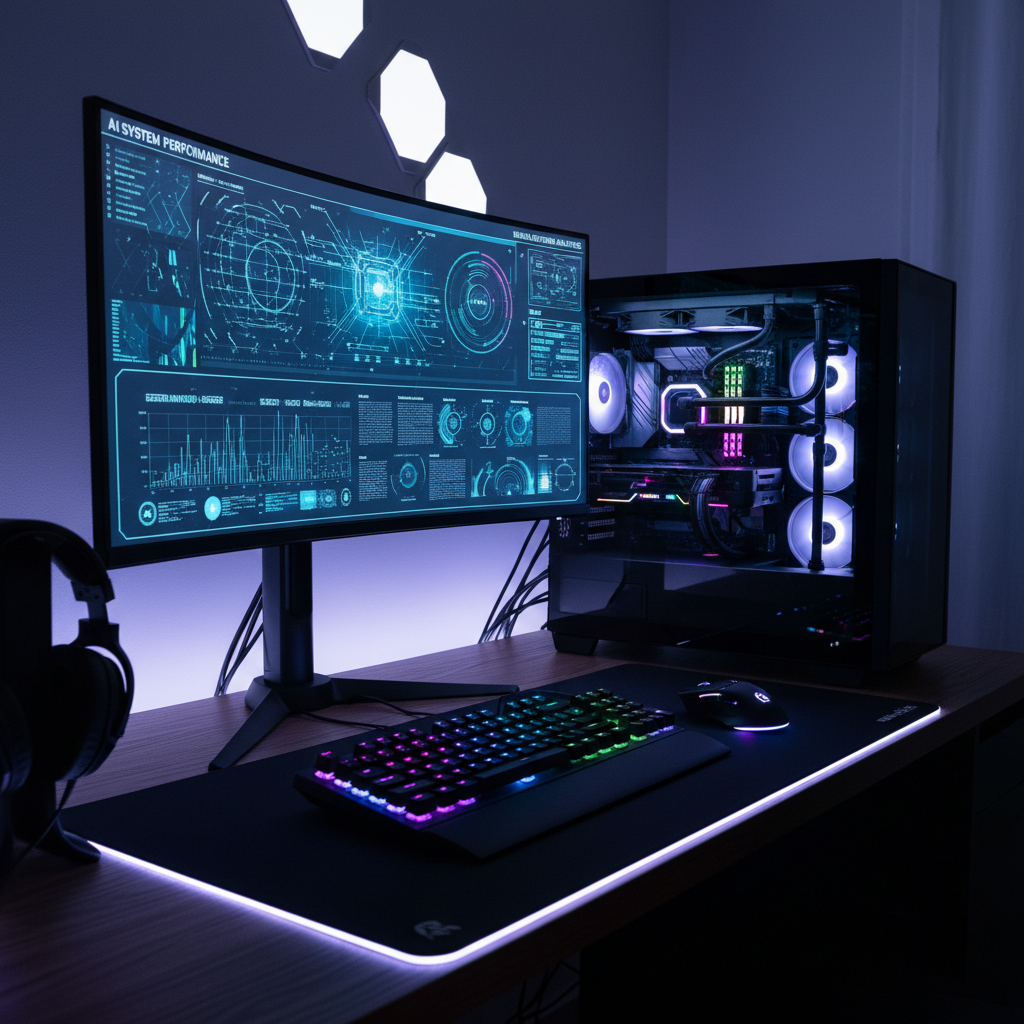
G-Assist enables players to access real-time system operation analytics, which include dynamic data charts for visualizing performance metrics. AI systems can learn to modify game settings and activate different features, which leads to advanced automated optimization possibilities. G-Assist enables users who want to maximize their performance to achieve GPU overclocking while forecasted performance improvements are displayed to streamline the traditionally intricate process.
Plugin Ecosystem and Peripheral Integration
Third-party plug-in support has allowed Nvidia to expand G-Assist’s capabilities. The AI assistant gains the ability to interact with devices from Logitech G, Corsair, MSI, and Nanoleaf, which facilitates features like thermal profile adjustments and LED light synchronization while expanding AI control past basic system settings to create a more integrated experience.
Localized AI Processing
With the introduction of “AI laptops” into the PC market, Nvidia wants customers to realize that desktop systems with dedicated GPUs have strong AI processing capabilities. Nvidia’s G-Assist operates on local machines by utilizing the processing strength of GeForce RTX GPUs instead of relying on cloud-based AI tools.
Nvidia demonstrates that G-Assist uses a small language model specially optimized for local execution, which delivers quick response times and improved privacy protection. The text-based installation occupies 3GB of storage while the voice control feature requires an additional 3.5GB, making the complete installation size 6.5 GB. A GeForce RTX 30, 40, or 50 series GPU with at least 12GB of VRAM is required for G-Assist to operate. G-Assist performance scales according to GPU specifications, and future updates will include support for laptop GPUs.
Running G-Assist on GPU locally offers benefits while introducing certain difficulties. Processing data locally provides advantages such as stronger privacy protections and lower latency, which results in faster interactions.
However, it also introduces performance considerations. The RTX 4070 showed increased GPU usage when interacting with G-Assist during testing. The AI response generation through inference requires substantial computational power, which may affect other simultaneous operations like resource-heavy gaming. When running Baldur’s Gate 3 at maximum settings, the frame rates dropped by around 20% due to G-Assist processing.
G-Assist could create additional performance bottlenecks in systems that operate near their current performance limits. G-Assist functions better when not running demanding games, but requires a high-performance GPU for regular and intensive usage.
The experimental design of G-Assist manifests through its sporadic performance delays and various bugs. Until further development, users should manually adjust their system and game settings for optimal performance.
G-Assist marks a major advancement in utilizing AI capabilities of gaming PCs, which indicates GPUs might soon deliver enriched and interactive user experiences. The ongoing progress in GPU technology makes it more feasible to integrate resource-intensive games with complex AI models seamlessly. Nvidia’s G-Assist currently offers an intriguing view of developing AI-enhanced gaming capabilities.