
- calendar_today August 20, 2025
A groundbreaking artificial intelligence model developed by researchers at Carnegie Mellon University, named LegoGPT, translates simple text descriptions into physically stable Lego structures. The system pushes innovation boundaries by designing Lego models that match textual descriptions while ensuring real-world assembly capability through human or robotic builders. LegoGPT operates on the crucial capability to understand textual descriptions like “a streamlined, elongated vessel” or “a classic-style car with a prominent front grille” and turns these into accurate Lego brick sequences that create stable structures. An autoregressive large language model learns to generate stable Lego constructions through training on a dataset containing more than 47,000 physically stable Lego designs, each associated with descriptive captions. The training process teaches AI systems to understand how language relates to stable Lego configurations, which enables accurate predictions of the next brick in a sequence to preserve structural integrity.
LegoGPT builds its technology on large language model principles from systems such as ChatGPT but shifts its prediction focus from words to bricks. The researchers achieved this by fine-tuning the instruction-following language model Meta’s LLaMA-3.2-1B-Instruct and combining it with additional specialized software. The specialized software tool verifies the generated designs’ physical stability through mathematical simulations of gravity forces and structural integrity principles. LegoGPT features an innovative “physics-aware rollback” mechanism that stands out. The system uses this intelligent feature to detect structural design flaws throughout the creation process. The AI system continues operation even when it detects a potential structural failure in part of the design. The system takes intelligent action by removing the problematic brick alongside any following bricks and then proceeds to test a new configuration. LegoGPT achieves its high rates of structural stability through this iterative design process driven by physical force simulations, which boosts the success rate from just 24 percent to an exceptional 98.8 percent.
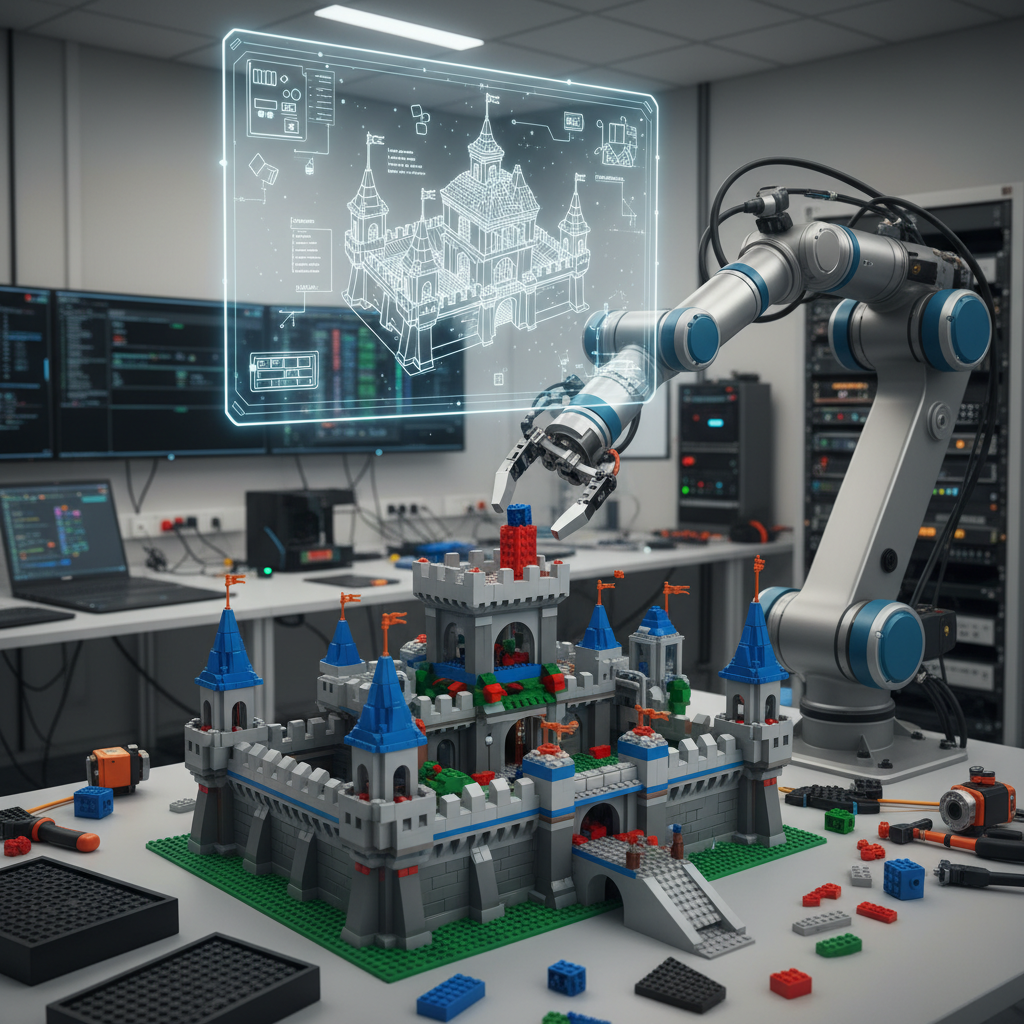
Researchers verified LegoGPT designs for real-world use by running complete experiments with both robots and humans constructing the models. The AI-generated models were assembled with a dual-robot arm system that had force sensors for precise manipulation according to predetermined brick sequences. Human testers joined the evaluation process by constructing several AI-generated designs themselves, which illustrated that LegoGPT generates Lego structures that are both buildable and stable based on the original text prompts. Compared to other 3D creation AI systems such as LLaMA-Mesh, LegoGPT stands out because it maintains a dedicated focus on structural integrity, which results in a superior percentage of stable structures when matched against its competitors.
The current version of LegoGPT shows impressive performance, but researchers have identified specific limitations. The system functions within a predetermined space of 20×20×20 units and works with a restricted assortment of eight standard Lego brick shapes. The research team has developed future development plans that will expand the brick library to include a broader spectrum of dimensions and brick types, like slopes and tiles, in response to existing constraints. The development of LegoGPT marks a significant step forward at the intersection of artificial intelligence and tangible creation since it shows how AI can overcome traditional barriers between digital design ideas and feasible real-world constructions, which leads to new practical applications beyond toy design.
LegoGPT’s achievements demonstrate potential impacts that reach far beyond the field of toy design and assembly. This technology shows potential for multiple applications because it can convert abstract textual instructions into structures that can be physically built. Architects could describe building components to an AI, which would then produce exact buildable instructions, or engineers could communicate mechanical part specifications to receive detailed assembly procedures. The foundational principles of LegoGPT, which integrate natural language understanding with physics simulation and iterative refinement, are applicable to any domain that requires digital designs to be translated into physical objects. The AI model’s capacity to revolutionize design and fabrication processes across multiple industries grows increasingly impactful as it advances to manage complex structures and diversified building materials alongside intricate instructions. The emphasis on stability and buildability represents a critical shift away from purely aesthetic digital design towards creating practical and useful AI-based design software.