
- calendar_today August 16, 2025
.
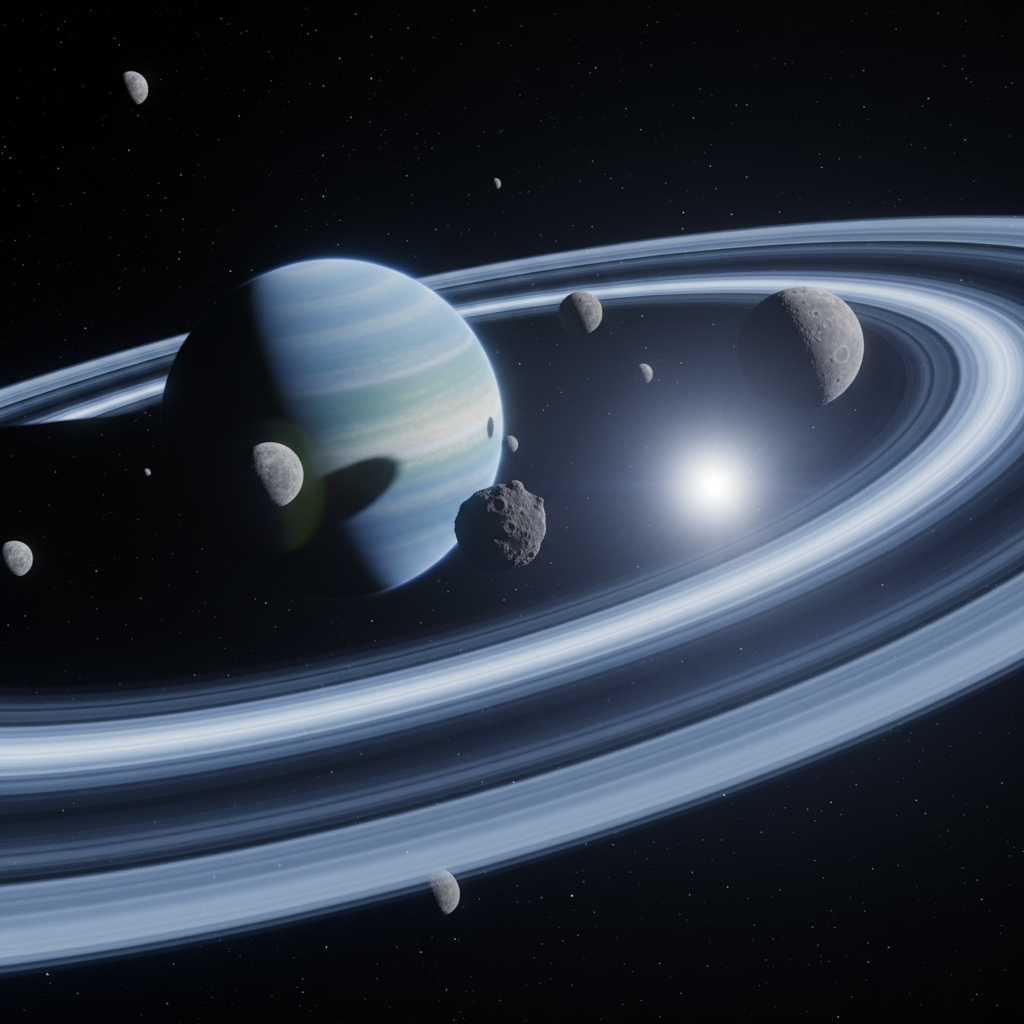
Astronomers with NASA’s James Webb Space Telescope (JWST) have detected a new moon orbiting Uranus. Uranus is the only ice giant planet in the solar system with an inclined rotation. The small moon, discovered on Feb. 2, 2025, increases the number of known moons around the planet to 29. Scientists say there are likely more to be found.
The dim object was first seen on February 2 in a set of 40-minute-long exposure images taken by Webb’s Near-Infrared Camera. Only about 6 miles (10 km) wide, the new moon is one of the smallest natural satellites ever found orbiting Uranus. Its small size and the brightness of the planet’s rings likely hid the moon from view during earlier flyby missions and observations with other telescopes. Even NASA’s Voyager 2 spacecraft, which flew past Uranus almost 40 years ago, did not see it.
“This is a small moon but an important discovery,” said Maryame El Moutamid, a solar system scientist at the Southwest Research Institute’s Solar System Science and Exploration Division in Boulder, Colorado. She is the principal investigator (PI) of a Webb program observing Uranus’ rings and inner moons. “The discovery is a testament to what Webb can do. We are writing a new chapter of discovery for Uranus.”
The provisional designation for the new moon is S/2025 U1. It lies about 35,000 miles (56,000 km) from Uranus’ center. It orbits nearly circularly and roughly coplanar with the planet’s equator. It orbits between two known moons, just outside of Uranus’ main ring system on one side and Ophelia, one of Uranus’ smallest outer moons, on the other. The moon’s proximity to its current orbit could mean that it formed there.
The moon appears dark, it is small, and it is also fast-moving against the background of Uranus and its bright rings. This made it a challenge for astronomers to filter it out and confirm its orbit. Webb can pick up faint infrared light, which the new moon emits. “Webb is capable of telling us what no other mission has been able to. We already got the first tantalizing glimpse of Uranus’ rings, weather, and atmospheric conditions,” El Moutamid said.
The discovery could help unravel a mystery about Uranus’ complex ring and moon system. Scientists think the new moon and parts of Uranus’ rings may have a common origin: perhaps fragments from an ancient collision or disruption. “The discovery raises questions about how many more small moons remain hidden around Uranus and how they interact with its rings,” El Moutamid added.
Uranus is known to have five major moons and a collection of smaller satellites that orbit very close to its equator. The newly detected object becomes the 14th small moon in the inner system. “Uranus has more small inner moons than any other planet, and these satellites are packed close together. We don’t know why these moons cluster so closely; their orbits come dangerously close to crossing one another, yet they seem stable,” El Moutamid said. She and her colleagues think these satellites could be shepherds that contain Uranus’ narrow rings.
Scott Sheppard, an astronomer at the Carnegie Institution for Science and co-discoverer of a Uranus moon in 2024, told SPACE.com that the discovery was “very exciting.” Sheppard was not involved in the new study. He noted that it is the closest thing to the inner ring system of Uranus and that Webb is just sensitive enough to see it.
“It’s an excellent discovery, Webb is so sensitive, you need it to detect these tiny objects,” Sheppard said. “This small moon is a new target of opportunity for Hubble observations. It’s great to find it now with Webb and continue this story with Hubble; it’s a real team effort.”
SETI Institute’s Matthew Tiscareno, who is also a co-PI in the Webb Uranus project, said the discovery hammers home the continuum between moons and rings. “Their complex inter-relationships hint at a chaotic history for this strange system,” Tiscareno said. The newly detected object is also even smaller and fainter than the faintest known Uranian inner moons, meaning there are more waiting to be found.
Sheppard said more moons could be waiting to be discovered, with sizes of a few kilometers or less. They could be revealed using long-exposure Webb images or a future spacecraft mission. “Maryame’s team will keep working on this discovery, refining its orbit and hunting for other satellites that are waiting to be found around Uranus,” El Moutamid said. “Discovering a new moon around Uranus is one more way we are helping scientists better understand how this strange system formed, how its rings work, and how to prepare for future missions to Uranus like NASA’s Uranus Orbiter and Probe.”