
- calendar_today August 14, 2025
.
Electric vehicle demand in the U.S. is facing renewed headwinds. Vehicle sales are slowing, at the end of more than a year of month-over-month growth, while charging infrastructure lags behind. Buyers have already walked away from EVs offered by Genesis and Volvo in large numbers, and both brands have taken note, reevaluating their offerings.
Compounding the challenge, the current administration is sending mixed signals to EV buyers by reducing subsidies and reversing vehicle pollution rules, leaving the federal government with fewer tools to encourage adoption. But analysts say the most significant EV barrier in the U.S. might already be in your garage.
Americans’ Garages as an EV Barrier
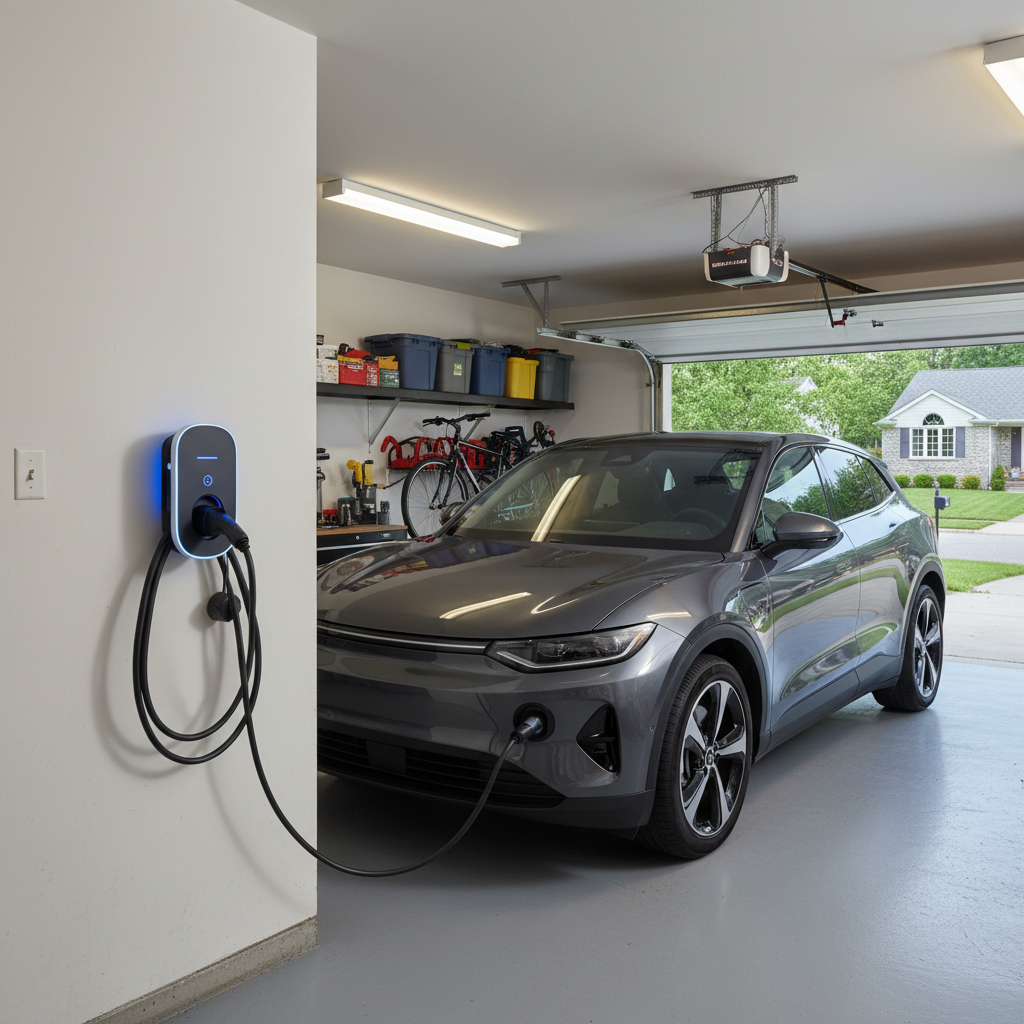
The biggest hurdle to EV adoption in the U.S. has long been surveys and interviews showing charging as the primary concern. A new market research note from Sam Abuelsamid, vice president of Telemetry, drills down on one contributing factor: what people do with their garages.
Fast-charging corridors get a lot of attention, but most EV charging occurs at home. An estimated 80 percent of all EV charging is done at a single-family residence using AC power. A recent survey of homeowners by the National Renewable Energy Laboratory (NREL) found that 42 percent already parked within reach of an outlet that could support 240-volt level 2 charging.
Parking close to a charging outlet might become more common in the future, too. According to Abuelsamid, “90 percent of all houses can add a 240 V outlet near where cars could be parked. Parking behavior, namely whether homeowners use a private garage for parking or storage, will likely become a key factor in EV adoption.”
Opening up more garage space to vehicles, not storage, would increase the number of homes with EV charging capabilities from the current 31 million to over 50 million. If new wiring is feasible, that figure would rise to more than 72 million. This is above Telemetry’s own most bullish case for EV penetration by 2035, which sees 33 million to 57 million vehicles on the road.
The same NREL data also highlights a key snag. Upwards of 34 million homes would need expensive electrical upgrades to support a level 2 charger. Level 2 chargers draw 240 volts of power but need to be able to supply at least 30 amps of electricity, sometimes requiring new wiring or even a full panel replacement, a process that can cost thousands of dollars.
Expensive installation requirements undercut the value proposition for EVs: the long-term cost savings over a gasoline-powered vehicle. When you factor in the cost of charging equipment, it’s possible to drive the total cost of ownership up to or above that of a comparable internal combustion engine (ICE) car.
More Pain for Apartments and Condos
Installing chargers and upgrading electrical panels are more than an inconvenience: it’s an insurmountable challenge for the 23 percent of Americans who live in multifamily housing such as apartments, condos, townhomes, or other complex dwellings. Here, the individual EV owner rarely has the autonomy to add chargers or select an electrician to install them.
The landlord, management company, or co-op board has the final say. In many cases, these organizations won’t budge or, if they agree to charging, lack the authority to actually install them. The cost is an issue, too: one multifamily co-op will need an entire panel upgrade, an $8 million investment, before two shared level 2 chargers can be installed. Wiring each parking spot, common in some condos and apartment buildings, increases the cost even further.
Multifamily dwellers are also often shut out of local or utility rebates for chargers. All this adds up to low EV penetration. Of the 1 million EV owners in multifamily housing, 11 percent currently park near a charger. EV-ready parking mandates in new construction requiring 20–25 percent of parking spaces to be equipped with chargers are one possible bright spot, but Telemetry still only expects 6.7 million to 11.4 million charging-capable spaces in multifamily housing by 2035, short of the market’s needs.
The Public Charging Divide
If home charging options remain limited, public charging will be all the more important. Telemetry estimates that 11.7 million to 14.3 million EV owners who own homes will still use public chargers in 2035, and another 7.8 million to 8.1 million EVs in multifamily housing will also need to use them.
Meeting that demand will require 523,000 to 586,000 DC fast chargers plus another 1.5 million to 1.6 million level 2 chargers across the U.S. But that doesn’t mean it will be easy. The electricity generation and distribution capacity needed to add a DC fast charging site at truck scales is already coming up against resistance from power companies, who are themselves under pressure as data centers, many of which are coming with their own AI-powered cooling systems, demand more of their resources.
EV uptake in the U.S. is far from a sure thing. In theory, over 70 million homes could support EV charging. In practice, a lack of available space in garages, high electrical upgrade costs, and the challenges of multifamily housing are all barriers to adoption. Even with significant expansion of public charging, supply could be outstripped by demand in the next decade.
One thing is certain: the success of EVs in the U.S. will depend as much on the condition of homeowners’ garages as on government policies and automaker strategies.